Order of Operations Worksheets
Printable order of operations worksheets that build from two-step expressions to parentheses, then exponents — each with 20 problems and an answer key — plus a PEMDAS/BODMAS reference card and a common-mistakes sheet.
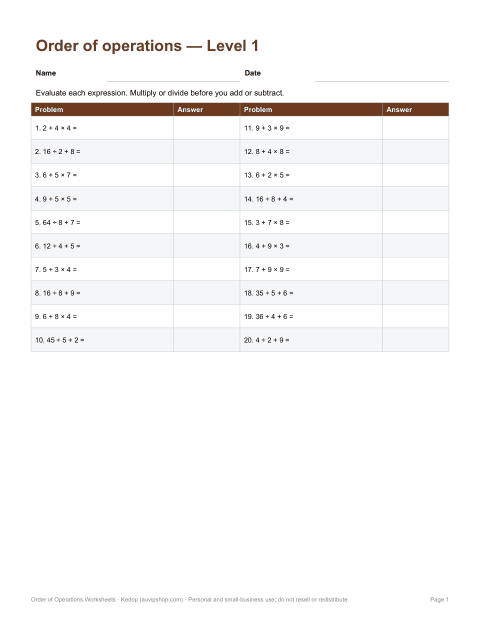
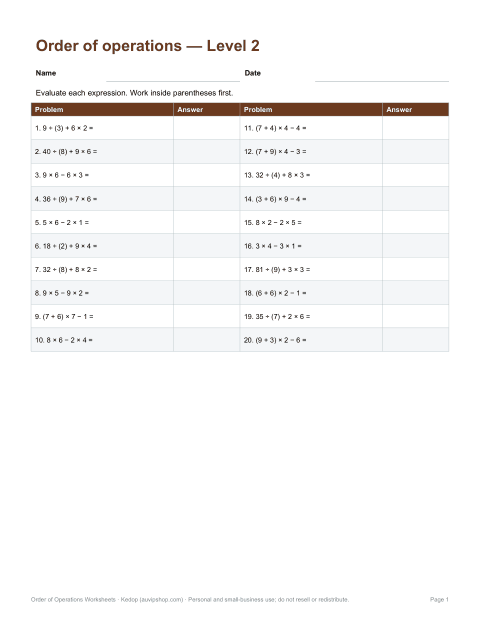
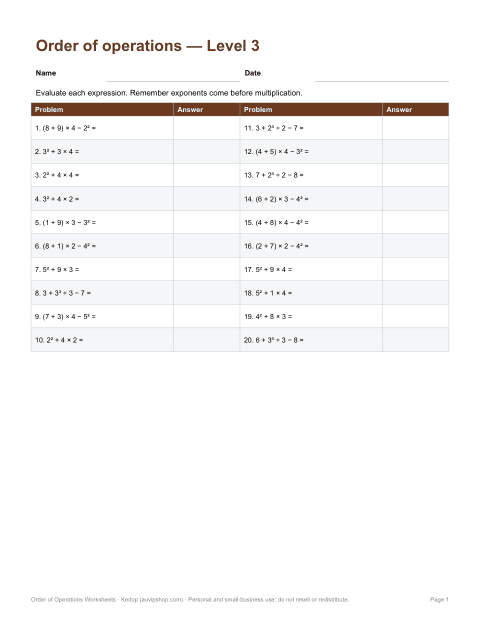
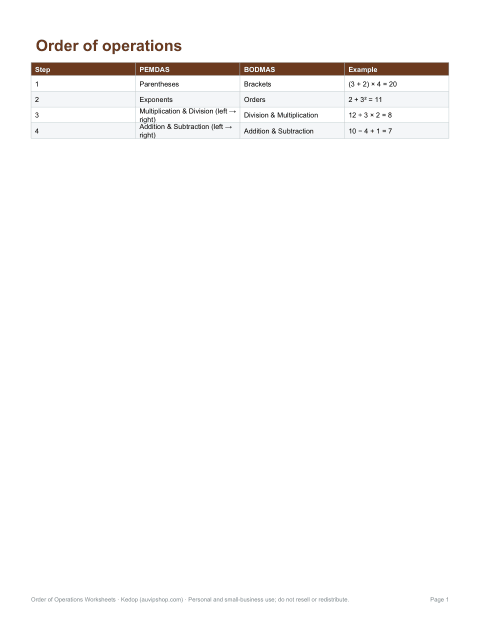
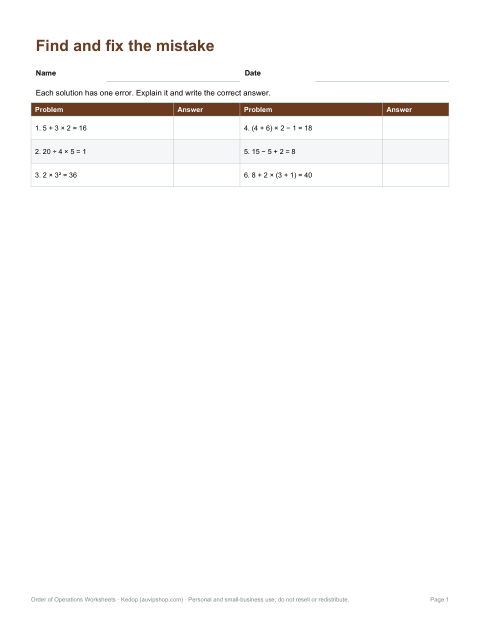
Order of Operations Worksheets
Three levels of PEMDAS/BODMAS worksheets with answer keys, a rules reference card and a find-the-mistake sheet.
- Level 1: two operations (PDF, DOCX)
- Level 2: parentheses (PDF, DOCX)
- Level 3: exponents (PDF, DOCX)
- Rules reference card (PDF, DOCX)
- Find the mistake (PDF, DOCX)
Formats: PDF, DOCX. Instant download after payment (link valid 72 hours, up to 5 downloads). AI-assisted: the templates were drafted with AI help and reviewed and laid out by Kedop.
$5.00 USD, one-time
Secure card checkout by Stripe. Full refund within 7 days — see the refund policy and license.
What the order of operations is
When an expression has more than one operation, mathematicians agree on an order so everyone gets the same answer. Without it, 3 + 4 × 2 could be 14 or 11. The agreed order is: work inside grouping symbols first (parentheses or brackets), then exponents (powers and roots), then multiplication and division from left to right, then addition and subtraction from left to right. So 3 + 4 × 2 = 3 + 8 = 11.
PEMDAS, BODMAS and BIDMAS
| Acronym | Used in | Stands for |
|---|---|---|
| PEMDAS | United States | Parentheses, Exponents, Multiplication/Division, Addition/Subtraction |
| BODMAS | UK, India, Australia and others | Brackets, Orders, Division/Multiplication, Addition/Subtraction |
| BIDMAS | UK | Brackets, Indices, Division/Multiplication, Addition/Subtraction |
| GEMS | Some US and Australian classrooms | Grouping, Exponents, Multiplication/Division, Subtraction/Addition |
They all describe the same rules. The most important detail is that multiplication and division have equal priority and are done left to right, and so are addition and subtraction — which the acronyms can hide. In 12 ÷ 3 × 2, divide first because it comes first: 4 × 2 = 8, not 12 ÷ 6 = 2.
What is in the pack
- Level 1: two operations — no parentheses, e.g. 7 + 3 × 4.
- Level 2: parentheses — e.g. (6 + 2) × 5 − 3.
- Level 3: exponents — squares and cubes with parentheses, e.g. 4² + 3 × 2.
- Answer keys for every level, on separate pages.
- Rules reference card — PEMDAS and BODMAS side by side with examples.
- Common mistakes sheet — find and fix the error in worked solutions.
- Editable Word versions for creating your own problems.
Worked examples
| Expression | Steps | Answer |
|---|---|---|
| 7 + 3 × 4 | Multiply first: 3 × 4 = 12; then 7 + 12 | 19 |
| (6 + 2) × 5 − 3 | Parentheses: 8; multiply: 40; subtract: 37 | 37 |
| 18 ÷ 3 × 2 | Left to right: 6 × 2 | 12 |
| 4² + 3 × 2 | Exponent: 16; multiply: 6; add | 22 |
| 20 − 8 + 3 | Left to right: 12 + 3 | 15 |
Common mistakes
- Always doing multiplication before division, or addition before subtraction, instead of working left to right.
- Forgetting to finish everything inside the parentheses first.
- Treating an exponent as multiplication by the exponent (3² as 6).
- Applying an exponent to the wrong number: in 2 × 3², only the 3 is squared.
- Calculators: basic calculators may evaluate left to right as you type; scientific calculators follow the order of operations.
How to use the worksheets
Introduce the rules with the reference card, then have students complete Level 1, showing one step per line. Move to Level 2 once they can explain why multiplication comes first. Level 3 suits grades 6 and up, after exponents are introduced. The common-mistakes sheet works well as a partner discussion: students explain what went wrong and fix it. All answers are whole numbers so students can focus on the order rather than arithmetic with fractions.
Who it is for
Students in grades 5–7 learning the order of operations, older students reviewing before algebra, homeschooling families, and tutors. Every problem was generated by a script and its answer computed automatically, so the keys are consistent.
Formats
Worksheets and keys are print-ready PDFs (US Letter; they also print on A4) and editable DOCX files.
Why the rules matter beyond school
Spreadsheets, programming languages and scientific calculators all follow the order of operations, so the same rules decide whether a budget formula or a line of code gives the right answer. In a spreadsheet, =A1+B1*C1 multiplies before adding, which is often not what the writer intended; parentheses make the intention explicit. Encouraging students to add parentheses whenever an expression might be misread is good practice for later work with formulas and code.
Frequently asked questions
What is PEMDAS?
Parentheses, Exponents, Multiplication and Division (left to right), Addition and Subtraction (left to right).
Does multiplication always come before division?
No, they have equal priority and are done from left to right.
What is the answer to 8 ÷ 2(2 + 2)?
Under the standard convention it is 16 (8 ÷ 2 × 4, left to right), though the notation is deliberately ambiguous and best avoided.
Are answer keys included?
Yes, for all three levels.
Was AI used to create the worksheets?
The problems and answers were generated by a script; explanations were drafted with AI assistance and reviewed by Kedop.